


Table of Contents
- How to Ship Fragile Custom Gifts: What You'll Need First
- Choosing the Right Packaging Materials for Fragile Items
- Step 1: Assess Your Custom Gift and Select the Right Box Size
- Step 2: Wrap and Cushion Your Fragile Custom Gift
- Step 3: Fill Empty Spaces and Consider Double Boxing
- Custom Packaging for Fragile Products: Protecting the Unboxing Experience
- Step 4: Label, Seal, and Choose Your Shipping Carrier
- Shipping Insurance for Fragile Items and Cost Considerations
Last Updated: August 2, 2026
How to Ship Fragile Custom Gifts: What You'll Need First
Learning how to ship fragile custom gifts requires careful planning and the right materials before you seal the first box. According to the National Retail Federation's 2026 shipping guide, improper packaging accounts for nearly 40% of shipping damage claims. This guide from CJmart covers everything you need to know to protect irreplaceable personalized items, whether a custom necklace, engraved photo frame, or handcrafted keepsake, so they arrive in perfect condition.
The stakes are higher with custom gifts. Unlike mass-produced items, a damaged personalized piece can't simply be replaced from inventory. It's one-of-a-kind and took time, thought, and significant investment to produce.
Before you pack, gather these essentials: a sturdy shipping box, cushioning materials like bubble wrap or foam inserts, shipping-rated packing tape, tissue paper or kraft paper for wrapping, and a fragile label or sticker.
Choosing the Right Packaging Materials for Fragile Items
The foundation of safe shipping starts with selecting materials that absorb impact and protect delicate surfaces.
Bubble wrap remains the gold standard for fragile items because it provides air-cushioned protection that absorbs shock. Wrap items individually, using at least two layers for delicate pieces like custom jewelry or glassware. Larger bubbles (5/16 inch) work better for heavier items, while smaller bubbles suit lightweight fragile goods.
Foam inserts and corner protectors add another layer of defense, especially for items with sharp edges or protruding elements like handles on personalized mugs. Pre-cut foam sheets fit snugly into corrugated boxes and prevent shifting during transport.
Crumpled kraft paper or packing paper serves as void fill, occupying empty space inside the box and preventing movement. It's cheaper than packing peanuts, more eco-friendly, and works effectively for most custom gifts.
Corrugated shipping boxes are essential. Never use regular cardboard boxes; they lack the structural integrity needed for fragile items. Look for boxes rated for shipping with double-wall construction (minimum 200-pound test strength).
Packing tape matters more than most realize. Use only pressure-sensitive tape rated for shipping. Apply tape in an H-pattern: down the center seam, then along each side seam where the flaps meet.
Step 1: Assess Your Custom Gift and Select the Right Box Size
What you're shipping determines how you ship it. A personalized ceramic mug requires different protection than a delicate custom necklace or framed family photo.
Ask yourself: Is this item breakable? Does it have protruding parts that could snap off? Is the surface easily scratched? Custom jewelry, glassware, ceramics, and electronics all require maximum protection.
Choose a box size that allows at least 2 inches of cushioning material on all sides, top, bottom, and all four sides. This is the minimum recommended by professional shippers. A box that's too small compresses cushioning, reducing its shock-absorbing effectiveness. A box that's too large creates excess movement inside.
The math is simple: measure your item's dimensions, add 4 inches to each measurement (2 inches per side), then find a box that matches. If your custom gift is 6 inches wide by 4 inches tall by 3 inches deep, you need a box at least 10 inches by 8 inches by 7 inches.
Undersizing is the most common mistake. Compressed cushioning can't absorb impact effectively. Professional shippers intentionally choose larger boxes to create space for proper cushioning layers.
Step 2: Wrap and Cushion Your Fragile Custom Gift
Start by wrapping the item in tissue paper or kraft paper. This first layer protects the surface from direct contact with bubble wrap and prevents ink transfer or scratching.
Next, wrap the item in bubble wrap with the bubbles facing inward. Wrap tightly enough to hold everything in place, but not so tight that you risk damaging delicate surfaces. For custom jewelry or small items, use at least two full layers of bubble wrap. For larger items like personalized drinkware or framed artwork, two to three layers provides adequate protection.
Secure the bubble wrap with small pieces of packing tape, only enough to hold it in place.
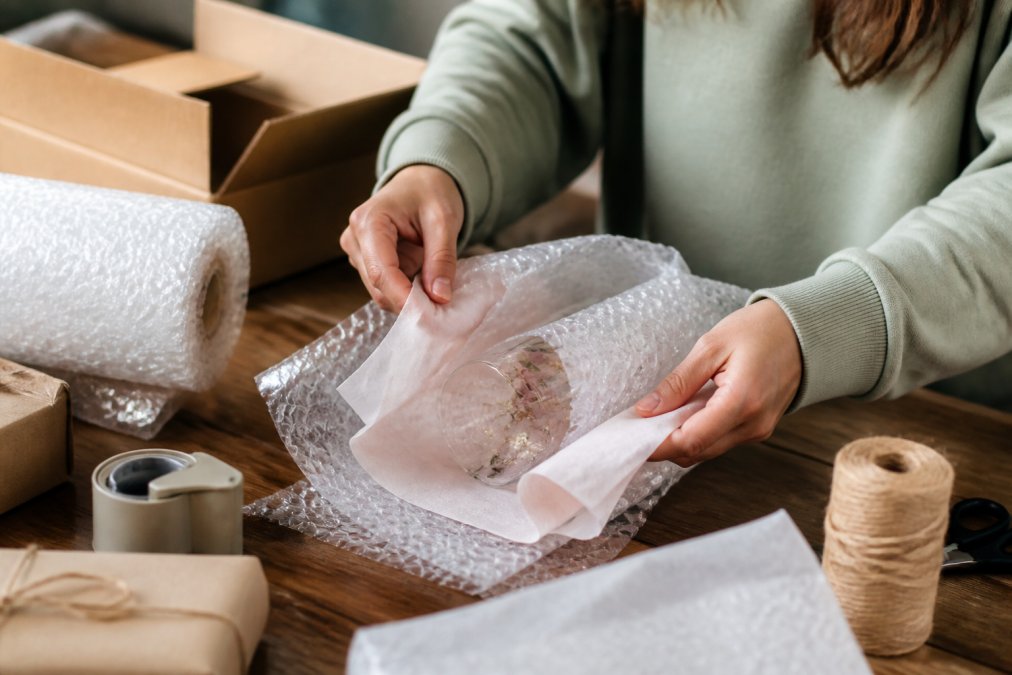
For items with handles, spouts, or other protruding elements, add foam corner protectors or wrap these areas with extra bubble wrap. A custom mug's handle is a common break point, protect it aggressively.
Once wrapped, place the item in the center of your prepared box (which should already have a 2-inch layer of cushioning material on the bottom). This centering ensures protection on all sides.
Step 3: Fill Empty Spaces and Consider Double Boxing
After placing your wrapped item in the center of the box, fill all remaining space with void fill material. This prevents any movement during transit. Even slight shifting can cause items to collide with the box walls.
Use crumpled kraft paper, packing peanuts, or air pillows to fill gaps. Work methodically around the sides and above the item, ensuring no empty pockets remain.
For custom gifts valued above a certain threshold, or for particularly fragile items like custom glassware, double boxing provides maximum protection. This technique involves placing your already-boxed item into a larger outer box with cushioning between the two boxes.
Here's how to double box:
- Pack your item in the inner box as described above
- Seal the inner box securely with shipping tape
- Place 2 inches of cushioning material on the bottom of a larger outer box
- Center the sealed inner box on this cushioning layer
- Fill all sides with cushioning material (2 inches minimum)
- Seal the outer box with shipping tape in an H-pattern
The outer box should be at least 4 inches larger in each dimension than the inner box.
Custom Packaging for Fragile Products: Protecting the Unboxing Experience
The unboxing experience is part of the gift itself, especially for personalized items. CJmart understands this deeply. When you order a custom piece, the moment of opening that box is meaningful.
Consider the recipient's first interaction with your package. Tissue paper in neutral tones like kraft or white adds elegance without adding cost. Wrap the cushioned item in tissue before placing it in the box to create a moment of discovery.
For custom gifts, consider including a small card that explains the item's personalization. "This necklace features your initials in our signature font" adds context and shows the care behind both the gift and its shipping.
A custom gift that arrives in a heavily cushioned, carefully packed box signals that the sender and maker took care with every detail. This perception is worth the small additional cost of quality packaging materials.
Step 4: Label, Seal, and Choose Your Shipping Carrier
Once your package is fully packed and sealed, apply a "FRAGILE" or "HANDLE WITH CARE" label prominently on at least two sides of the box. Research from the Shipping and Fulfillment Technology Association shows that packages with fragile labels experience 18% fewer damage incidents than unlabeled packages.
Include your return address and the recipient's address clearly on the package. Use a waterproof label or permanent marker. Smudged addresses can cause delays or misrouting, increasing damage risk.
Seal your package using the H-tape method: apply tape down the center seam where the top flaps meet, then along both side seams. Use only shipping-rated tape.
Now, choosing the right shipping carrier matters. Different carriers handle fragile items differently, and their liability policies vary significantly.
USPS Priority Mail offers basic shipping at competitive rates but provides limited tracking and insurance options. It works for moderately fragile items over shorter distances.
UPS Ground and UPS Next Day Air provide excellent tracking, better handling standards, and higher insurance limits. UPS is often preferred for valuable custom gifts.
FedEx Ground and FedEx Express similarly offer strong tracking and handling standards. FedEx Express (overnight or 2-day) is ideal for time-sensitive custom gifts.
The choice depends on distance, urgency, and value. For a high-value custom necklace shipping across the country, paying extra for UPS Next Day Air or FedEx Express is justified.
Shipping Insurance for Fragile Items and Cost Considerations
Shipping insurance is non-negotiable for fragile custom gifts. It protects both you and the recipient in case of damage during transit.
Most carriers offer basic coverage included in shipping charges, but it's minimal. USPS Priority Mail includes up to $100 in coverage. These limits are rarely enough for custom gifts, which often have significant value.
Purchase additional declared value coverage or a standalone shipping insurance policy. This typically costs $1-3 per $100 of declared value. For a $150 custom necklace, you'd pay $1.50-4.50 for full coverage.
When declaring value, be honest. The declared value should match what you'd charge to replace the item. For custom gifts, that's often the original creation cost plus materials.
Document everything: photograph the packed item before sealing the box, keep receipts for all packaging materials, and save the shipping label and tracking number. If damage occurs, you'll need this documentation to file an insurance claim.
The total cost of shipping a fragile custom gift includes the shipping charge, insurance, and packaging materials:
| Component | Typical Cost Range |
|---|---|
| Shipping (ground, 1-3 days) | $8-25 |
| Shipping (express, overnight) | $25-60 |
| Shipping insurance | $1-5 |
| Packaging materials | $2-8 |
| Total for standard shipping | $11-38 |
| Total for express shipping | $28-73 |
Many senders choose to absorb shipping costs as part of the gift experience. CJmart, for example, offers free shipping on orders over $70, a benefit that removes the cost barrier for customers while ensuring proper packaging standards are met.
Proper shipping for fragile custom gifts isn't cheap, but it's far cheaper than replacing a damaged item or disappointing a recipient.
Shipping fragile custom gifts safely requires planning, the right materials, and attention to detail at every step. The difference between a package that arrives damaged and one that arrives perfect often comes down to whether the sender invested time in proper cushioning, box selection, and carrier choice. When you're sending something personalized and irreplaceable, these steps aren't optional, they're essential to honoring the thought and care behind the gift itself. Start with CJmart's approach: thoughtful packaging that protects both the item and the unboxing experience, because custom gifts deserve nothing less than careful handling from creation to delivery.
Frequently Asked Questions
What's the best way to pack a fragile custom gift for shipping?
Start by wrapping the item in tissue paper or soft cloth, then add a layer of bubble wrap secured with tape. Place it in the center of a sturdy corrugated box surrounded by at least 2 inches of cushioning material like foam inserts or crumpled paper on all sides. For high-value personalized gifts, consider double boxing for extra protection during transit. Seal the outer box with h-tape method (horizontal and vertical strips) to ensure the package stays secure throughout delivery.
Is shipping insurance worth it for fragile custom gifts?
Yes, especially for personalized items that can't be easily replaced. Shipping insurance typically costs a percentage of the declared value and covers damage or loss during transit. Most shipping carriers offer coverage options, though standard policies have limits. For custom gifts with sentimental value or high replacement costs, declared value insurance protects your investment. Check with your carrier about coverage limits and exclusions before purchasing.
How much does it cost to ship fragile items?
Shipping costs depend on package weight, dimensions, destination distance, and the carrier you choose. Fragile items often cost more due to dimensional weight calculations and specialty handling. Factors affecting price include box size, packing material weight, and whether you select signature confirmation or expedited delivery. Contact your shipping carrier for a specific quote, or compare rates across USPS, UPS, and FedEx for personalized gifts to find the best value for your needs.
What materials are best for packing fragile custom gifts?
Use a combination of materials for maximum protection: bubble wrap for direct contact with the item, foam inserts or air pillows for void fill, and crumpled paper as a secondary cushioning layer. Sturdy corrugated boxes provide the outer protection. For extremely delicate personalized items like custom glassware or ceramics, consider custom packaging designed specifically for fragile products. Avoid newspaper alone, as it offers minimal protection during impact or crush situations.
This article was written using GrandRanker


