


Table of Contents
- Why Personalized Signs Work in Small Homes
- Small Space Wall Decor Ideas That Avoid Visual Clutter
- Best Materials for Custom Home Signs
- How to Arrange Gallery Walls in Small Rooms
- Scale, Proportion, and Placement Strategies
- Rental-Friendly Mounting and Lighting Options
- Common Mistakes to Avoid with Personalized Signs
- Final Thoughts on Styling Your Space
- Frequently Asked Questions
Last Updated: September 6, 2026
Personalized signs are decor pieces that feature custom names, dates, quotes, or monograms, and styling them well in a small home comes down to intentional placement rather than square footage. This guide from CJmart walks through practical strategies for making personalized signs feel polished and purposeful, even when wall space is limited.
Below, we'll cover material selection, gallery wall arrangements, scale and proportion rules, and rental-friendly mounting. These approaches help you avoid the common trap where a thoughtful gift ends up looking like an afterthought.
Why Personalized Signs Work in Small Homes
A personalized sign is an interior design anchor that gives a room an instant sense of identity. In small spaces, where every item must earn its place, a custom piece pulls double duty: it decorates and it tells a story.
The key advantage is versatility. A well-chosen sign can define an entryway, mark a reading nook, or add character above a console table. Because the design is yours, it naturally coordinates with existing furniture and color schemes.
Personalized signs work best when they serve as the room's visual anchor. Choose one meaningful piece rather than several small ones to reduce visual weight and make the space feel curated, not crowded.
Small Space Wall Decor Ideas That Avoid Visual Clutter
The main risk with small space wall decor is overcrowding. A single wall can quickly feel busy when you combine signs, frames, and shelves without a plan. The solution is to edit ruthlessly and group items with intention.
Start with one hero piece, then build around it. For example, a personalized wooden family name sign can anchor a grouping of two or three small framed photos. Keep a consistent gap of 3 to 4 inches between items so the arrangement reads as a deliberate collection rather than scattered decor.
Another effective idea is to use vertical space. In a narrow hallway or beside a door, mount a tall, vertical sign or stack smaller pieces in a column. This draws the eye upward and makes ceilings feel higher.
Best Materials for Custom Home Signs
The best material for your personalized sign depends on the room's humidity and light exposure, the visual weight you want the piece to carry, and how much upkeep you are willing to perform.
Solid wood (oak, maple, pine, walnut) is the most popular choice for personalized signs because it reads as warm and permanent, but it is also the heaviest option. A 24-inch by 12-inch solid oak sign can weigh 8 to 12 pounds, requiring a stud finder or heavy-duty drywall anchors (engineeringtoolbox.com). Wood is porous; in a kitchen or bathroom, humidity changes can cause warping or cracking. If you choose wood for a moisture-prone area, look for a sign sealed with polyurethane or marine-grade varnish.
Metal (steel, aluminum, or tin) offers different trade-offs. Aluminum is lightweight (2 to 4 pounds for a similar size) and resists corrosion, making it a better choice for a bathroom or covered porch. Steel is heavier and more industrial but can rust if scratched. Metal's thin profile allows it to sit flush against the wall, taking up less visual depth than a chunky wooden slab, useful in a narrow hallway or galley kitchen. The downside is that metal conducts temperature, so a sign on an exterior wall in a cold climate may feel cold and develop condensation.
Acrylic and plexiglass are the go-to for a modern or minimalist aesthetic. These materials are lightweight (often under 2 pounds) and can be cut into precise geometric shapes that are hard to achieve in wood. Acrylic is also the easiest to clean; a microfiber cloth and mild glass cleaner keep it streak-free. However, it scratches easily and can yellow after a few years in direct sunlight, so place it away from the strongest light. Acrylic shows every fingerprint, making it not ideal for a high-touch area like a mudroom.
Canvas and fabric signs are the lightest option (usually under 1 pound) and the safest for rental walls, as they can be hung with a single adhesive strip. They add a soft, textured element that makes a small room feel less hard-edged. The trade-off is durability: canvas is prone to fading and can absorb odors in a kitchen, so it is best used in a low-traffic bedroom or home office.
A practical way to decide is to match the material to the room's function. For a living room or entryway, wood or metal gives a permanent, anchored feel. For a bathroom, laundry room, or kitchen, choose sealed metal or acrylic. For a bedroom or a rental where you want zero wall damage, canvas or a thin acrylic panel is the smarter play. Before you order, check the product listing for the sign's weight and whether it includes mounting hardware. A matte finish hides smudges and glare better than a gloss, a real advantage in a room with overhead lighting.
How to Arrange Gallery Walls in Small Rooms
Arranging a gallery wall in a small room requires planning on the floor before you put a single nail in the wall. Lay out your pieces on kraft paper, trace around them, and tape the paper to the wall to test the arrangement, letting you adjust spacing and balance without making extra holes.
Start with your personalized sign as the centerpiece, then arrange frames around it. Keep the outer edges aligned to create a clean, rectangular shape. A common mistake is hanging pieces too far apart, which makes a small wall feel fragmented; keep gaps tight, around 2 to 3 inches, to create a unified block.
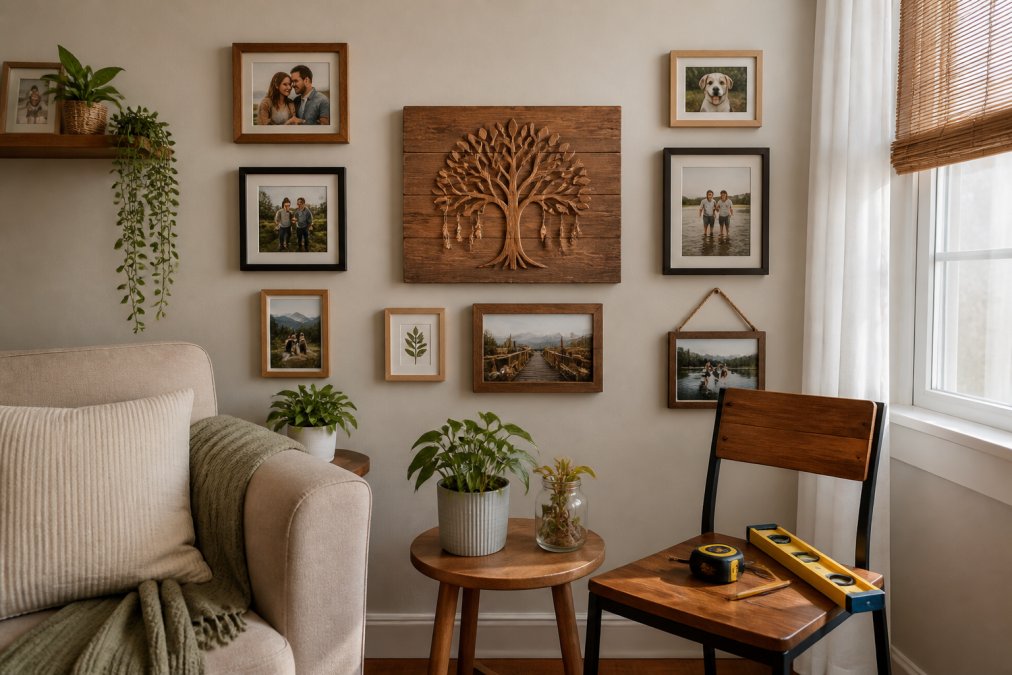
For small rooms, consider a salon-style hang that uses vertical space efficiently. Start from the center and work outward, maintaining consistent spacing. This fills the wall without making the room feel smaller. Use lightweight frames and adhesive strips when possible to keep the arrangement flexible.
Scale, Proportion, and Placement Strategies
Scale and proportion are the most overlooked aspects of styling personalized signs in small homes. A sign that is too large dominates a tiny room, while one that is too small gets lost. A practical rule is that a sign should span roughly two-thirds to three-quarters of the width of the furniture below it, for example, a 30-inch-wide console table pairs well with a sign around 20 to 24 inches wide.
Placement height also affects how a room feels. Eye level, typically 57 to 60 inches from the floor to the center of the piece, works for most rooms (nga.gov). In a dining area or above a desk, hang the sign slightly lower since people are often seated. Above a bed or sofa, leave 6 to 10 inches of breathing room between the furniture and the sign.
In small homes, every inch counts. A sign at the end of a narrow hallway can create a focal point that draws the eye forward, making the space feel longer. Consider multi-functional signage, such as a piece with hooks for keys or a small shelf, to maximize utility in tight spots.
Rental-Friendly Mounting and Lighting Options
Most small-home dwellers are renters, so the biggest constraint is not wall space but the security deposit. The standard advice, use adhesive strips, only works for signs under 5 pounds. For anything heavier, you need a system that spreads the load without leaving a grid of holes.
For signs under 5 pounds (canvas, thin acrylic, lightweight metal): Use Command brand picture-hanging strips, not just the foam squares. The strips are rated for specific weights, and they work best when you use two sets per sign, placed vertically along the top and bottom edges. The key is surface preparation: wipe the wall with isopropyl alcohol and let it dry completely. Press the strip against the wall for 30 seconds, then wait one hour before hanging the sign to let the adhesive cure. Do not use these on textured walls, wallpaper, or walls painted with flat paint, as the paint will peel.
For signs 5 to 15 pounds (solid wood, heavy metal): The safest rental-friendly option is a single-hook picture-hanging system, such as the OOK brand. This system uses one small nail (about 1/16-inch diameter) that leaves a hole you can fill with a dab of spackle and touch up with paint in under five minutes. The hook is angled so the weight of the sign pulls the nail against the drywall, not out of it. This is far more secure than adhesive for a heavy sign, and it is a single, easily patched hole. Position the hook over a stud if possible; if not, use a drywall anchor rated for the sign's weight.
For signs over 15 pounds: Do not rely on adhesive or a single hook. Use a two-hook wire system or a French cleat. A French cleat is the most secure method, but it requires cutting a notch in the back of the sign. Many custom sign makers offer a cleat as an add-on. If you are renting, this is still viable because the cleat mounts to the wall with two screws, leaving two small holes that are easy to patch. The trade-off is that a cleat makes the sign sit flush against the wall, which is ideal for a narrow hallway but means you cannot easily swap the sign without unmounting the cleat.
Lighting is the second half of this equation. In a small room, the right light makes a sign feel like a curated gallery piece rather than a flat decoration. The most effective approach is a low-voltage picture light mounted directly above the sign. These lights, often battery-operated or plug-in, cast a focused beam that highlights the sign's texture and color without washing out the rest of the room. Look for a light with a color temperature around 2700K to 3000K (warm white), which flatters wood tones and does not create a clinical glare (energy.gov). Avoid cool white (4000K+) lights, which can make a wooden sign look dull and a metal sign look harsh.
If you cannot mount a picture light, use a floor lamp with a directional shade placed 3 to 4 feet from the sign. Angle the shade so the light grazes the sign's surface at a 30-degree angle, creating subtle shadows that add depth, especially on carved or routed wooden signs. For a sign in a dark corner, a plug-in wall sconce with an adjustable arm gives you the same effect without any hardwiring.
A final rental-specific trick is to plan your layout on the floor first. Lay the sign on the floor where you intend to hang it, step back, and check the scale. This avoids the cycle of mounting, disliking, unmounting, and patching holes. When you do patch, use a small putty knife to apply spackle, let it dry, sand it smooth, and touch up with a matching paint sample. This entire process takes under 10 minutes per hole and will pass most move-out inspections.
Common Mistakes to Avoid with Personalized Signs
The most common mistake is choosing a sign that clashes with your existing decor instead of complementing it. A rustic wooden sign can look out of place in a sleek, modern apartment. Match the material and finish of the sign to your room's dominant style for architectural harmony.
Another frequent error is poor typography. Overly ornate scripts can hurt font legibility, especially from a distance. Choose a font that is readable at a glance and suits the room's mood, and avoid mixing more than two font styles on a single sign.
Overcrowding is also a problem. Resist the urge to fill every empty wall. A single, well-placed sign often has more aesthetic impact than a cluster of mismatched pieces. Finally, do not ignore proportion and scale: a tiny sign on a large, empty wall feels lost, while an oversized piece can overwhelm a small room.
Final Thoughts on Styling Your Space
Styling personalized signs in small homes is about making deliberate choices that respect your space. Focus on one meaningful piece, choose materials that suit your lifestyle, and plan your arrangement before hanging anything. These steps turn a simple custom sign into a design feature that enhances your home's character.
For a curated selection of signs and keepsakes that celebrate your family's milestones, explore the collection at CJmart. Our pieces are designed and assembled in the USA, with free shipping on orders over $70. Each item is handled with care to ensure you are satisfied with the result. Get started with CJmart and find a sign that makes your small space feel unmistakably yours.
Frequently Asked Questions
How do I hang personalized signs in a small apartment without damaging walls?
Use removable adhesive strips rated for the sign's weight, or opt for lightweight materials like canvas or thin wood. Command hooks work well for signs under 5 pounds. For heavier pieces, consider a tension rod system or furniture placement that lets you lean the sign on a shelf or mantel. Always clean the wall with rubbing alcohol before applying adhesive and hold the strip in place for 30 seconds. This keeps your security deposit safe while still letting you enjoy personalized signs.
What are common signage mistakes in interior design?
The most common mistake is choosing a sign too large for the wall, which overwhelms the space. Another frequent error is poor font legibility: script fonts that look pretty up close become unreadable from across the room. Ignoring color coordination also causes problems, especially when the sign clashes with your existing palette. Finally, hanging signs at the wrong height, either too high or too low, disrupts the room's visual balance. Measure your wall space and sight lines before committing to a piece.
How can I make personalized signs look cohesive with my existing decor?
Pull your color palette directly from the room's existing accents. If your throw pillows feature navy and cream, choose a sign with those tones. Match the frame or mounting hardware finish to other metals in the room, like your lamp bases or cabinet pulls. For a curated feel, repeat the sign's material elsewhere, such as pairing a reclaimed wood sign with a wood coffee table. This creates a cohesive aesthetic without making the sign blend in completely.
What are the best materials for custom home signs in humid areas?
For kitchens and bathrooms where humidity fluctuates, choose sealed metals like aluminum or stainless steel, or acrylic signs that resist warping. Unsealed wood can bow or crack in damp conditions. If you prefer a wood look, select a sign with a clear polyurethane finish on all sides, including the back. Canvas signs also handle humidity well and stay lightweight for easy mounting. Always check the product description for moisture resistance before ordering a personalized sign for these rooms.
Personalized signs are a meaningful way to make a small home feel personal, but success depends on thoughtful placement, material choice, and scale. By following the strategies above, you can avoid visual clutter and create a cohesive look that reflects your family. When you are ready to find the perfect piece, CJmart offers USA-assembled options backed by a customer satisfaction guarantee. Shop now to find a sign that fits your space and your story.


