


Table of Contents
- Understand Your Drinkware Options and Materials
- Screen Printing vs. Laser Engraving Drinkware
- Custom Drinkware Minimum Order Quantity Explained
- Best Promotional Drinkware for Branding
- Prepare Your Design Files Correctly
- Navigate the Ordering Process and Lead Times
- Quality Checks Before You Buy Custom Drinkware Online
- Conclusion
Last Updated: August 15, 2026
Understand Your Drinkware Options and Materials
Material choice determines durability, insulation performance, cost, and customization quality. The three main options, stainless steel, plastic, and glass, each have distinct advantages and limitations.
Stainless Steel vs. Plastic vs. Glass
Stainless steel is the most popular choice for promotional drinkware. It's durable, insulates well, and feels premium. Stainless steel tumblers resist dents and scratches, making them ideal for corporate gifting. The material works with both screen printing and laser engraving, though laser engraving produces more permanent results.
Plastic drinkware costs significantly less and works well for budget-conscious bulk orders. It's lightweight and won't shatter, but doesn't feel as premium, shows wear faster, and limits customization methods. Screen printing adheres better to plastic than laser engraving. Plastic is also less eco-friendly, though BPA-free options are now standard.
Glass offers aesthetic appeal and premium feel but sacrifices durability. It breaks easily, making it risky for promotional items meant for regular use. Laser engraving on glass produces crisp results, while screen printing is less common. Glass is also heavier to ship, increasing logistics costs.
For most custom drinkware purchases, stainless steel strikes the best balance between cost, durability, and customization quality.
Insulation and Temperature Retention
Double-wall insulation is essential for drinkware that will actually be used. Vacuum-sealed construction keeps beverages hot or cold for hours, making your branded tumbler a practical tool people reach for daily.
Single-wall drinkware is cheaper but offers no insulation benefit. Your drink reaches room temperature quickly, and the product feels less premium.
Double-wall, vacuum-sealed tumblers cost more but deliver measurable value. A quality vacuum-sealed tumbler keeps coffee hot for 6-8 hours and cold drinks cold for 12+ hours. This performance makes recipients more likely to use the item, increasing brand visibility.
When buying custom drinkware online, check insulation specifications carefully. Cheaper options sometimes claim "double-wall" without true vacuum sealing, which delivers minimal thermal benefit. Real vacuum-sealed construction is worth the investment for branded drinkware.
Screen Printing vs. Laser Engraving Drinkware
The customization method you choose affects how your logo looks, how long it lasts, and the final cost.
When to Choose Screen Printing
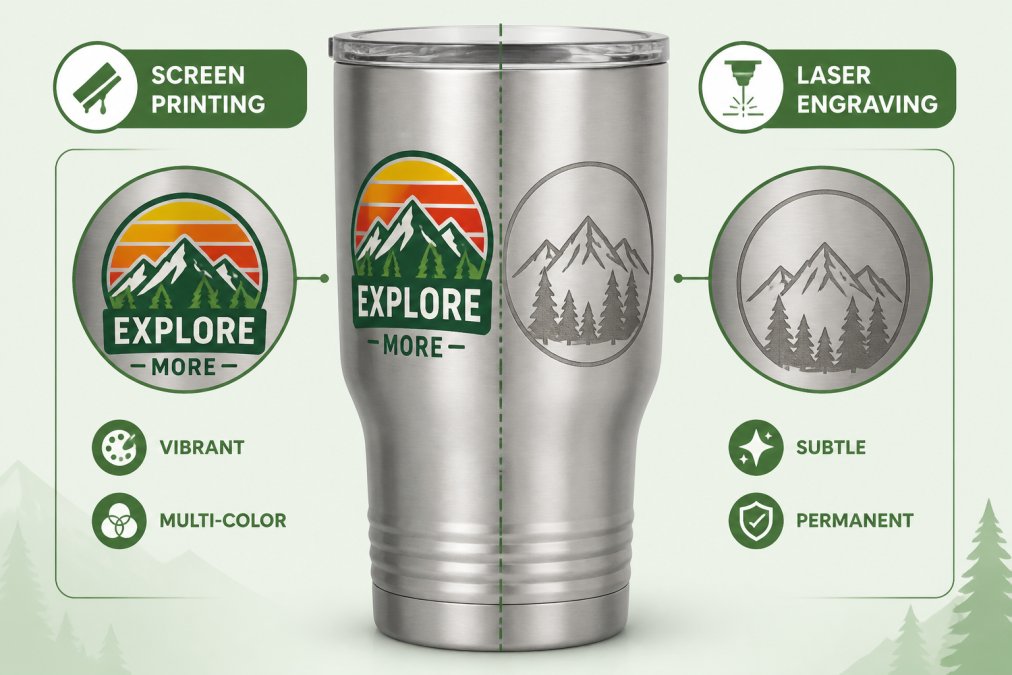
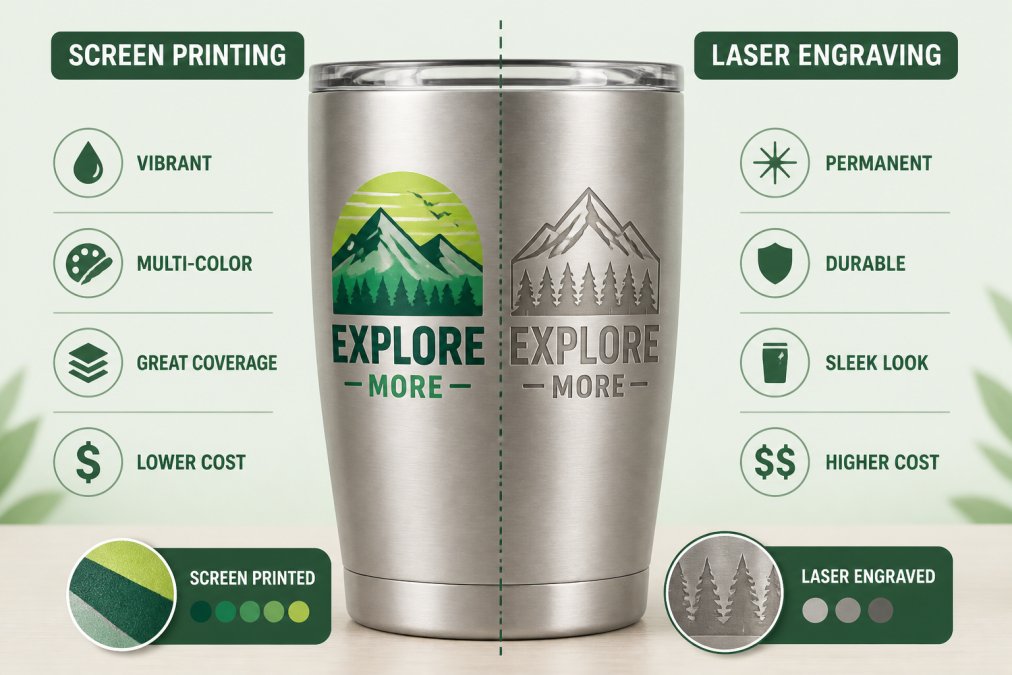
Screen printing applies ink directly to the drinkware surface. It's cost-effective at scale, produces vibrant, full-color prints, and works on nearly any material including stainless steel, plastic, and glass.
Screen printing shines when you want bold color, Pantone color matching, or complex multi-color designs. If your logo includes gradients or photographic elements, screen printing is your best option.
The trade-off: screen-printed designs can fade over time with heavy use and dishwashing. The ink sits on the surface rather than becoming part of the material. Screen printing also works best with larger minimum order quantities, typically 100+ units. The cost per unit drops significantly as order size increases.
When to Choose Laser Engraving
Laser engraving removes material from the surface, creating a permanent mark that won't fade. On stainless steel, engraving produces a bright, silvery mark that contrasts sharply with the darker base material.
Laser engraving excels for detailed work: fine lines, small text, and intricate patterns all come through clearly. The permanence is a major advantage, engraved logos last the lifetime of the product.
The limitations: laser engraving works best on stainless steel and glass. On plastic, the engraving can look dull or discolored. Laser engraving cannot produce full-color prints; you're limited to single-color designs.
Laser engraving typically has lower or no setup fees and can handle smaller minimum order quantities, sometimes as low as 10-25 units. This makes it ideal for smaller custom orders or personalized gifts.
Custom Drinkware Minimum Order Quantity Explained
Minimum order quantity (MOQ) is the smallest number of units you must purchase. It's one of the most important factors affecting your total cost and timeline.
Screen printing typically requires MOQs of 100-500 units. The reason: setup takes time and cost, so vendors spread that across larger quantities to keep per-unit pricing reasonable.
Laser engraving usually has much lower MOQs, often 10-50 units. Since there's minimal setup, vendors can accommodate smaller orders without sacrificing profitability.
Print-on-demand services sometimes offer MOQs as low as 1 unit, but you'll pay significantly more per item.
When buying custom drinkware online, clarify MOQ early. Compare total cost across different vendors and methods, not just per-unit pricing, because a lower per-unit price means nothing if it requires buying more units than you need.
Best Promotional Drinkware for Branding
Not all drinkware works equally well for brand visibility. The style, size, and material you choose determine whether your logo gets noticed and used.
Tumbler and Travel Mug Styles
Tumblers are the workhorse of promotional drinkware. A 16-20 oz tumbler is the sweet spot, large enough to hold a full coffee, small enough to fit in car cup holders and backpacks. Tumblers with lids are more practical than open designs.
Travel mugs are similar but typically larger (18-24 oz) and designed specifically for on-the-go use. They appeal to commuters and busy professionals.
Water bottles represent a different use case, appealing to fitness-oriented audiences. A 24-32 oz insulated water bottle positions your brand around health and active lifestyles.
For corporate gifting where you want recipients to perceive quality, stainless steel is the better choice.
Logo Placement and Brand Visibility
Logo placement determines whether your brand actually gets seen. The ideal placement is the front or side at eye level, roughly the middle third of the tumbler. Avoid placing logos on the bottom, back, or very top.
For maximum brand visibility, consider a wraparound design that covers more surface area. This ensures your logo is visible from nearly every angle.
A logo that's too small disappears visually. A logo that's too large looks overwhelming. The sweet spot is typically 2-3 inches wide for a tumbler design.
Color contrast is critical for visibility. A light logo on a dark tumbler reads clearly. A similar-color logo becomes nearly invisible. If your brand uses subtle colors, consider adding a contrasting background or border.
Prepare Your Design Files Correctly
Poor file preparation is one of the most common reasons custom drinkware orders get delayed or come back looking wrong.
Vector Artwork and File Specifications
Vector artwork is non-negotiable for professional results. Vector files use mathematical formulas to define shapes, which means they scale infinitely without losing quality. Raster files (JPEGs, PNGs) are made of pixels and become blurry when enlarged.
Use Adobe Illustrator or similar software to create vector files. Export as PDF, AI, or EPS format, never as JPEG or PNG. Standard requirements include 300 DPI minimum resolution, CMYK color mode (not RGB), and outlines converted (text converted to curves).
Convert all text to curves or outlines before submitting. This ensures your design prints exactly as intended.
Pantone Color Matching for Accuracy
If brand color accuracy matters, you need Pantone color matching. Pantone is an industry standard color system that ensures consistent color reproduction across different vendors and materials.
Define your brand colors using Pantone numbers, not RGB or hex codes. When you specify "Pantone 286," every printer in the world will produce the same blue.
When buying custom drinkware online, ask which Pantone colors the vendor can reproduce. Provide a Pantone reference with your file submission, including both the Pantone number and a visual reference.
Navigate the Ordering Process and Lead Times
Understanding the ordering workflow and timeline prevents surprises and missed deadlines.
Understanding Setup Fees and Bulk Pricing
Setup fees cover the cost of preparing your design for production. Setup typically ranges from $50-200 depending on design complexity and vendor. This fee is charged once per order, not per unit.
Bulk pricing works in tiers. Your first 50 units might cost $8 each. Units 51-100 might cost $7 each. This tiered structure means your per-unit cost drops as you order more.
Setup fees become negligible as order size increases. On a 100-unit order, a $100 setup fee adds only $1 per unit. On a 500-unit order, it adds only $0.20 per unit.
When buying custom drinkware online, ask for a complete quote that includes setup fees, per-unit pricing, and total cost. Don't compare per-unit prices across vendors without accounting for setup fees and MOQ differences.
Shipping and Logistics Considerations
Shipping cost and time depend on order size, destination, and carrier. Drinkware is heavy and bulky, so shipping costs are significant. A 100-unit order of stainless steel tumblers weighs roughly 50-60 pounds and might cost $50-150 to ship.
Lead time includes production time plus shipping time. Screen printing typically takes 5-10 business days for production, plus 3-7 days for shipping. Laser engraving is usually faster, 2-5 business days production, plus shipping.
Plan your timeline carefully. If you need drinkware for an event two weeks away, you might not have time for screen printing with standard shipping. Laser engraving with expedited shipping might be your only option.
CJmart handles custom drinkware orders with attention to timeline and quality. Our USA-based production means shorter lead times than overseas manufacturers, and our team communicates clearly about delivery expectations upfront.
Quality Checks Before You Buy Custom Drinkware Online
Quality problems usually emerge after you've already paid and the product arrives. Inspecting samples and understanding quality standards prevents costly mistakes.
Print Durability and Material Testing
Before committing to a large order, request a sample and put it through actual use: wash it in the dishwasher, use it daily for a week, expose it to sunlight. Screen-printed designs should resist fading. Laser-engraved designs should show no signs of wear.
For screen printing, durability depends on ink quality and application technique. Good-quality screen printing lasts hundreds of washes. Test this yourself by hand-washing and dishwasher-washing a sample multiple times.
Examine the finish for defects: rough edges, uneven seams, poor welding on the base. These indicate lower manufacturing standards.
BPA-Free and Dishwasher-Safe Standards
BPA-free is now standard for any plastic drinkware, but verify it explicitly. Reputable vendors only use BPA-free materials.
Dishwasher-safe is important for practical daily use. If your branded tumbler isn't dishwasher-safe, recipients will hand-wash it or stop using it. Most quality stainless steel tumblers are dishwasher-safe, but some have special coatings or insulation that requires hand-washing.
Check the vendor's care instructions for temperature limits and whether the lid is dishwasher-safe.
Reviewing Samples and Previews
Always request a physical sample before ordering large quantities. A sample costs $20-50 but prevents ordering thousands of units that don't meet expectations.
When reviewing a sample, check print or engraving quality, color accuracy, material quality, functionality, and finish for defects.
Ask the vendor for a digital preview as well, a mockup showing your design on the drinkware. Digital mockups can be misleading about color, size, and overall appearance, so don't rely on them alone.
If the sample doesn't meet your expectations, communicate this before ordering. A good vendor will make adjustments or explain why the sample represents the best they can do.
Buying custom drinkware online requires attention to material choice, customization method, design preparation, and quality standards. Start with a clear understanding of your needs, whether you're prioritizing insulation, brand visibility, budget, or durability, and let that drive your choices on material, customization method, and vendor selection. CJmart's team can help guide you through this process, ensuring your custom drinkware order meets your expectations for quality and brand representation. Shop Now and explore our selection of premium custom drinkware options designed to celebrate meaningful moments with lasting quality.
Frequently Asked Questions
What's the difference between screen printing and laser engraving for custom drinkware?
Screen printing applies ink through a mesh screen onto the drinkware surface, creating vibrant, full-color designs ideal for logos with multiple colors. Laser engraving uses heat to etch designs directly into the material, producing a permanent mark that won't fade or wash off. Screen printing works best on flat surfaces and handles complex artwork well. Laser engraving excels on curved drinkware and creates a more durable, professional appearance for minimalist designs or text.
What is the custom drinkware minimum order quantity?
Minimum order quantities vary by vendor and customization method. Screen printing typically requires 50-100 units minimum, while laser engraving may have lower minimums starting at 25-50 pieces. Print-on-demand options sometimes accept smaller orders of 10-25 units but with higher per-unit costs. Check with your vendor for exact minimums based on your chosen drinkware style and printing method, as requirements differ for tumblers, water bottles, and travel mugs.
How do I ensure my logo looks good on curved drinkware surfaces?
Request a digital preview or mockup before production to see how your design wraps around the curved surface. Use vector artwork rather than raster images for crisp, scalable logos. Consider laser engraving for curved surfaces since it handles contours better than screen printing. Keep important design elements centered on the flattest part of the drinkware. Work with your vendor to adjust logo size and placement specifically for the drinkware's curve and dimensions.
How long does it take to receive custom drinkware orders?
Standard lead times typically range from 2-4 weeks for custom drinkware, depending on order size and production method. Rush options may be available for an additional fee if you need items faster. Shipping time varies based on destination but usually adds 3-7 business days. When ordering for specific events or deadlines, communicate your timeline upfront and ask about expedited production options to avoid delays.
This article was written using GrandRanker


