


Table of Contents
- How to Choose a Safe Metal for Custom Jewelry
- Quick Comparison: Top Hypoallergenic Metals at a Glance
- 1. Implant-Grade Titanium: The Safest Bet for Severe Allergies
- 2. Platinum: Premium Purity for Heirloom Pieces
- Is 14k Gold Good for Sensitive Skin? What to Know
- 3. 316L Surgical Stainless Steel: Durable and Budget-Friendly
- Nickel Allergy Jewelry Symptoms and Metals to Avoid
- How to Clean Personalized Jewelry Without Damaging It
- Frequently Asked Questions
Last Updated: September 5, 2026
Choosing what metal is best for personalized jewelry for sensitive skin comes down to one question: how reactive is the alloy against your skin chemistry? This guide from CJmart breaks down the safest metals for custom pieces, which alloys to avoid, and how to care for personalized jewelry so it stays comfortable for years.
How to Choose a Safe Metal for Custom Jewelry
Sensitive skin jewelry is only as safe as the base metal it is made from. Plating and coatings can wear away, exposing whatever alloy sits underneath, so the material itself must be biocompatible from the start.
Nickel is the leading cause of metal allergy, triggering allergic contact dermatitis in a significant portion of the population. When nickel ions leach from an alloy through sweat, they bind with skin proteins and cause an immune response. The result is redness, swelling, itching, and sometimes blistering at the point of contact.
Why Your Skin Chemistry Matters More Than the Metal Label
Two people with the same 'sensitive skin' diagnosis can react differently to the same metal because skin pH and sweat composition vary significantly. Sweat with a lower pH (more acidic) accelerates corrosion, releasing more ions, including nickel, into the skin. This is why a piece of 14k gold might feel fine in winter but cause a rash during summer workouts.
This also explains why some people react to metals marketed as 'hypoallergenic.' For instance, 316L stainless steel contains trace nickel. In most people the alloy binds that nickel tightly, but on skin with high acidity or heavy sweating, the surface can break down slightly, releasing enough nickel to trigger a reaction in someone with a severe allergy.
How Engraving Changes the Risk Profile
Personalized jewelry involves engraving, stamping, or soldering, processes that alter the metal's surface. Engraving cuts through the outer layer, exposing fresh alloy underneath. This is not a problem for solid titanium or platinum, which are uniform throughout, but for plated pieces it is a dealbreaker: the cutter slices through the rhodium or gold layer, exposing the base metal, often brass or a nickel-heavy alloy, directly to your skin.
Even for solid metals, engraving creates microscopic crevices that trap sweat, soap, and moisture, creating a localized environment where corrosion happens faster than on a smooth surface. This is why a plain band might be fine but the same metal with a deep engraving causes irritation. Choose metals with high corrosion resistance, titanium, platinum, or 14k gold, and keep engraved areas clean and dry.
The Three Questions to Ask Before Ordering
Before ordering a custom piece, ask the maker three questions: What is the exact grade of the metal? Is it solid metal or plated? And does the alloy contain any trace nickel? A reputable jeweler should answer all three without hesitation.
Testing Your Existing Jewelry at Home
If you already own pieces that you suspect are causing reactions, you can test them before discarding them. Home nickel test kits using dimethylglyoxime (DMG) are available at most drugstores or online for under $15 (the FDA). Rub a swab on the metal surface; if it turns pink or red, nickel is present. This is especially useful for testing earring posts or necklace clasps, areas that often contain hidden nickel even in pieces labeled 'hypoallergenic.'
For a more practical test, wear the piece for a full day on a small area of skin, such as the inside of your wrist, and monitor for any reaction over 48 hours. This is not a substitute for a patch test by a dermatologist, but it is a useful screening method.
Quick Comparison: Top Hypoallergenic Metals at a Glance
The table below summarizes the top metals for personalized jewelry, weighing biocompatibility against durability and budget. Each option works for different needs, so use this as a starting point before reading the detailed sections.
| Metal | Nickel-Free | Durability | Best For | Price Range |
|---|---|---|---|---|
| Implant-Grade Titanium | Yes | Excellent | Severe allergies, lightweight earrings | $20 - $100 |
| Platinum | Yes (95%+ purity) | Excellent | Heirloom daily-wear pieces | Varies by weight |
| 14K Solid Gold | Yes (alloy-dependent) | Good | Everyday necklaces and rings | $50 - $300+ |
| 316L Surgical Steel | Low release rate | Excellent | Budget-friendly daily wear | $15 - $60 |
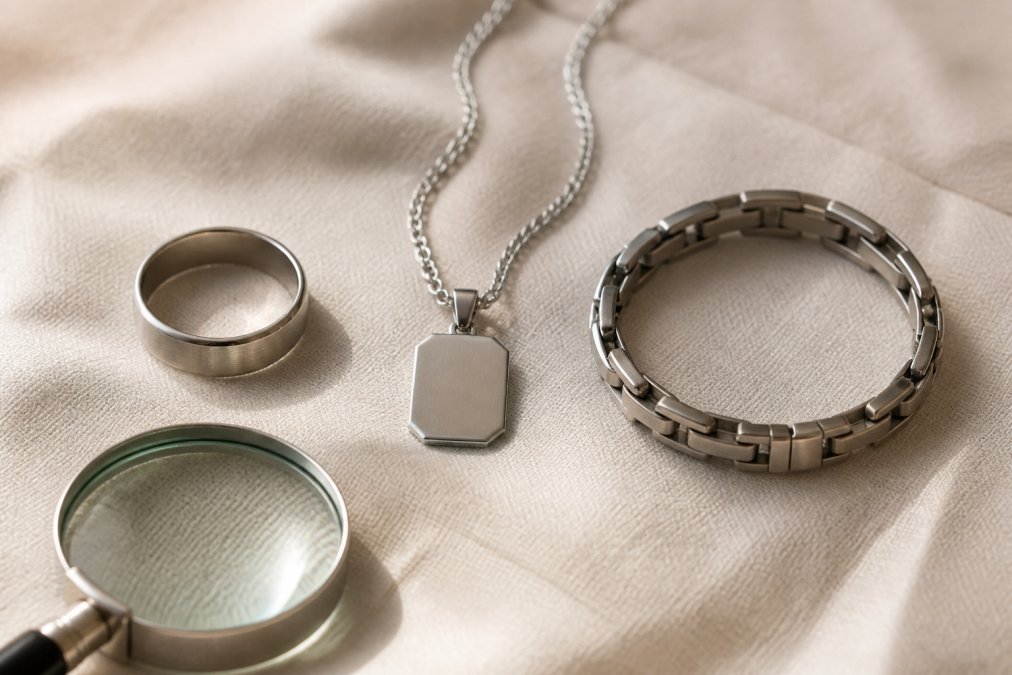
1. Implant-Grade Titanium: The Safest Bet for Severe Allergies
Implant-grade titanium is the most biocompatible metal available for jewelry, which is why surgeons use it for medical implants and bone screws (the NIH). It is naturally nickel-free, non-reactive, and highly resistant to corrosion from sweat and body chemistry.
Titanium is also remarkably lightweight, roughly 40% lighter than stainless steel, making it comfortable for earrings and large personalized pendants. Despite its light feel, it is exceptionally strong and scratch-resistant.
The trade-off is aesthetics: titanium lacks the warm glow of gold or the bright white of platinum, so it suits modern, understated designs better than traditional heirloom styles.
2. Platinum: Premium Purity for Heirloom Pieces
Platinum is the gold standard for hypoallergenic luxury. Most platinum jewelry is 95% pure platinum, with the remaining 5% typically composed of cobalt, copper, or ruthenium rather than nickel. Its high density makes it exceptionally durable and naturally tarnish-resistant.
For personalized heirloom pieces like wedding bands or anniversary pendants, platinum is the best investment. It develops a soft patina over time, holds engravings crisply, and, unlike white gold, which needs periodic rhodium replating, maintains its color indefinitely.
The main drawback is cost: platinum is roughly twice as expensive as 14k gold per gram, and its density means a piece needs more metal by weight. For a once-in-a-lifetime custom piece, the premium is justified.
Is 14k Gold Good for Sensitive Skin? What to Know
14k gold is good for sensitive skin for most people, provided it is solid rather than plated. The alloy contains 14 parts pure gold and 10 parts other metals, usually copper, silver, and zinc, with gold making up 58.3% of the mixture. Because the gold content is high, the reactive metals are diluted enough that most wearers tolerate it well.
The exception is 14k white gold. To achieve its bright white color, white gold is often alloyed with nickel and then coated with rhodium plating. If you have a known nickel allergy, skip white gold entirely and choose yellow gold, rose gold, or platinum instead.
For personalized pieces, 14k yellow or rose gold is an excellent choice. It resists oxidation, holds engravings beautifully, and works for daily wear without constant maintenance. If your sensitivity is moderate rather than severe, 14k gold offers the classic aesthetic that titanium and steel cannot match.
3. 316L Surgical Stainless Steel: Durable and Budget-Friendly
316L surgical stainless steel is a practical, affordable option for sensitive skin jewelry. The "L" denotes low carbon content, which improves corrosion resistance, and the 316L grade is specifically formulated to minimize nickel release. While it does contain trace nickel, the alloy structure binds it tightly, so most people with mild sensitivities wear it without issue.
Steel excels at durability, resisting scratches, rust, and tarnishing, making it ideal for rings, bracelets, and everyday personalized pieces. It is also the most budget-friendly option on this list.
The catch is for those with severe nickel allergies. Even the low nickel release rate of 316L can trigger a reaction in highly sensitive individuals. If you have experienced blistering or severe dermatitis from jewelry before, choose titanium or platinum instead of stainless steel.
Nickel Allergy Jewelry Symptoms and Metals to Avoid
Nickel allergy jewelry symptoms typically appear within 12 to 48 hours of contact (the American Academy of Dermatology). Common signs include redness, itching, swelling, dry patches, and in more severe cases, blisters or oozing at the contact site. The reaction is localized, appearing where the metal touches the skin, such as earlobes, fingers, or the neckline.
Beyond nickel, several metals commonly trigger reactions in sensitive individuals:
- Sterling silver (92.5% silver) is alloyed with copper, which can oxidize and cause green discoloration or irritation on some skin types
- Copper and brass oxidize rapidly and can stain skin green
- Gold-plated or gold-filled items expose the base metal once the layer wears through
- Cobalt, sometimes used as a platinum alloy, is a lesser-known but real allergen
The Hidden Risk of PVD Coatings on Personalized Pieces
Physical Vapor Deposition (PVD) coatings are often marketed as a solution for sensitive skin, a thin layer of titanium nitride or similar material applied over a base metal to create a hypoallergenic surface. This is common in budget-friendly personalized jewelry, especially in colored pieces. The problem is that PVD is a coating, not a solid metal, and its durability depends on the thickness of the layer and the quality of the application process.
On a smooth ring band, a good PVD coating can last for years. But on a personalized piece with engraving, the coating is compromised from the start: the engraving process cuts through the PVD layer, exposing the base metal underneath, often stainless steel or even a cheaper alloy. Even if the engraving is done before coating, the edges of the engraved letters are thin and prone to chipping, and over time the coating wears away at these edges.
A common pattern is that a PVD-coated piece feels fine for the first few months, then starts to cause irritation as the coating degrades. If you are considering a PVD-coated piece for a personalized item, ask the maker whether the coating covers the engraved areas and what the warranty is for coating wear. Most reputable jewelers will advise you to choose a solid metal instead.
Why Solid Metals Are the Only Safe Choice for Custom Work
For personalized jewelry, solid construction is not just a preference, it is a safety requirement. Engraving, stamping, and soldering all create points where a coating can fail. Solid metals like titanium, platinum, and 14k gold are uniform throughout, so even if the surface is scratched or worn, the material underneath is the same safe alloy.
If you have a confirmed metal allergy, always request the metal grade in writing before ordering. A reputable seller will happily confirm that a piece is solid titanium, platinum, or 14k gold with no nickel content. If a seller cannot confirm the grade or construction method, that is a red flag, move on.
How to Clean Personalized Jewelry Without Damaging It
Cleaning personalized jewelry requires gentler methods than mass-produced pieces because the engraved areas can trap dirt and moisture. For titanium and surgical steel, warm water with mild dish soap and a soft-bristled brush works well. For platinum and gold, the same method applies, but avoid abrasive polishes that can wear down fine details.
A simple routine keeps custom pieces looking new:
- Soak the piece in warm soapy water for 5 minutes
- Gently brush engraved areas with a soft toothbrush
- Rinse thoroughly and pat dry with a lint-free cloth
- Store pieces separately to prevent scratching
Avoid ultrasonic cleaners if your piece has a matte finish or delicate engraving. The vibrations can dull surface treatments over time. For heavily tarnished platinum, a professional jeweler can restore the finish without damaging the piece.
Finding a custom piece that is both personal and comfortable should not require a chemistry degree. At CJmart, we understand that a personalized necklace or ring only matters if you can actually wear it. Our curated collection of personalized jewelry is designed and assembled in the USA, and we back every order with a 100% customer satisfaction guarantee. If you are unsure which metal will work for your skin, reach out to our team before ordering, and we will help you choose a piece that is as safe as it is sentimental. Get started with CJmart and find jewelry made for life's meaningful moments.
Frequently Asked Questions
What metal is most safe for sensitive skin jewelry?
Implant-grade titanium and platinum are the safest options for sensitive skin. Both are naturally nickel-free and biocompatible, meaning they resist corrosion and won't react with your skin. For personalized pieces like necklaces or rings, titanium offers lightweight comfort, while platinum provides a dense, premium feel. If you have severe metal allergies, these are your most reliable choices.
Is sterling silver or gold better for sensitive skin?
14k solid gold is generally better than sterling silver for sensitive skin. Sterling silver often contains copper and other alloys that can oxidize and cause irritation. Solid 14k gold contains a higher percentage of pure gold, reducing the risk of reactions. However, white gold can contain nickel, so opt for yellow or rose gold, or ensure white gold is rhodium-plated for protection.
How do I know if my jewelry contains nickel?
Check the jewelry's stamp or hallmark. Look for "316L stainless steel," which has a low nickel release rate, or "titanium" and "platinum," which are naturally nickel-free. Avoid terms like "base metal" or "alloy" without specifics. You can also use a home nickel test kit with a swab and solution; if the swab turns pink, nickel is present.
Can I get personalized jewelry engraved on hypoallergenic metals?
Yes, all the hypoallergenic metals discussed, including titanium, 14k gold, platinum, and 316L stainless steel, can be engraved. Laser engraving is the preferred method for titanium and stainless steel because it doesn't compromise the metal's integrity. For gold and platinum, traditional hand engraving works well. Always confirm with the jeweler that the engraving process won't introduce any reactive materials.
This article was written using GrandRanker


